Archive | Uncategorized RSS feed for this section

Hash’s Faves: “The Ballad of You & Me & Pooneil”

31 Jan

After_Bathing_At_Baxters.net_Last week I said that I was tired of writing about dead people, and Lord, I still am, but this one’s kind of personal.

With all due respect to Glenn Frey and Mic Gillette, both of whom were fine musicians whose work I greatly loved, when I heard about the death of Paul Kantner Thursday night I felt something more than the tug of nostalgia. Kantner was the leader of the 60’s San Francisco band Jefferson Airplane, a band that provided the soundtrack to some of the formative years of my life (singer Marty Balin started the band, but Kantner evolved, or some say bullied his way, into the leadership role). The band went through many changes, including several name changes, but for me the classic lineup included Kantner on guitar and vocals, Balin on vocals, Grace Slick on vocals and occasional keyboard, guitarist Jorma Kaukonen, bassist Jack Casady and drummer Spencer Dryden. Kantner was probably the weakest member of the group; Balin and Slick were strong singers with remarkable instruments, Kaukonen was (and is) a good guitarist with strong roots in country blues, Casady remains my favorite bass player of all time, and Dryden brought a certain jazz sensibility to the band. Kantner was not a great guitar player, and his voice had a quality that, as they say, took some getting used to. Many of the songs that he wrote for the band were not the band’s best, and many of them have not aged well.

But that’s precisely why he was so important to the band, I think. He was the political conscience of the band, and he wrote about things he felt strongly about, whether anyone liked it or not. My favorite songs from their recordings tend not to be Paul’s tunes – they actually ranged pretty far for a band of that era, when bands took it as a point of pride to write their own material. They covered songs by David Crosby, the enigmatic Fred Neill, Judy Henske (actually, a song that she sang a lot, ”High Flying Bird,” by Billy Edd Wheeler) and traditional folk and blues tunes. Kantner was generous about sharing writing duties on their records with all of the other band members – none of that “Okay, George and Ringo get one tune each!” business. To my knowledge he never took a guitar solo, and he only occasionally sang lead. He had a unique ear for harmony as a singer; the chief difference between the Airplane’s harmony singing and everyone else’s (Crosby, Stills and Nash, The Beach Boys, The Band, The Eagles) was that they based much of their part-singing on quartal rather than diatonic harmony (a trait they shared with the Engish band Pentangle). Kantner seemed to gravitate towards harmony lines that created a feeling of suspension and ambiguity.

They were simultaneously a product of the time (the hippie 60’s) and creators of the zeitgeist. Whether this was a conscious effort on Kantner’s part or just the way that things happened, the band behaved much like a jazz band, in that musicians were always sitting in and guesting on their records and gigs; the Airplane famously lived in a communal house at 2400 Fulton in the Haight-Ashbury neighborhood of San Francisco, and I think he also saw the band as a communal family. Kantner himself often alluded to his Teutonic tendency towards control, but I’d have to say that during those early years he didn’t seem like a guy who felt like he had to protect his turf.

He co-wrote the version of ”Wooden Ships,” with David Crosby and Stephen Stills, that appears on the JA album ”Volunteers,” and I think it’s superior to the version on CSN’s debut album. Of course CSN’s version is gorgeous and the playing is competent, but the Airplane’s version has some rough edges, especially in Kantner’s vocal verses, that humanizes it, and it has a wider story arc and a more interesting dynamic.

In 1971, with the Airplane in the throes of dissolution, Kantner released a curious “solo” album called ”Blows Against The Empire,” credited to Jefferson Starship. Later on the Airplane would be officially called the Jefferson Starship, but that was really a different band than this one, and the spin-off band, called Starship, was another completely different animal. The Blows Against The Empire band was an ad-hoc bunch of San Francisco players, including members of The Grateful Dead, Crosby Stills and Nash and Santana (many of whom would also make the unjustly obscure David Crosby solo album ”If I Could Only Remember My Name”). The theme of the album was one of Kantner’s personal obsessions, a science-fiction conceit of leaving Earth and colonizing other planets; he and Slick (Crosby’s hilarious nickname for the couple was Baron Von Tollbooth and the Chrome Nun) had just had a daughter, China, and I guess he really didn’t like the school district. The album’s kind of a mess, but I also find it charming that Kantner could talk his record company into it.

Kantner died from complications from a heart attack, He was 74 years old.


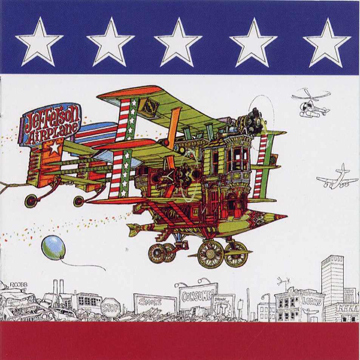
In honor of Kantner’s memory, this week’s pick is ”The Ballad Of You And Me And Pooneil,” by The Jefferson Airplane. The song was written by Kantner, who plays guitar and shares lead vocals with Grace Slick and Marty Balin. This is a live version, featuring a pretty cool solo by bassist Jack Casady; guitarist Jorma Kaukonen and drummer Spencer Dryden round out the classic lineup. For a sonically better version check out the original recording on their 1967 album ”After Bathing At Baxter’s.”

This song kind of typifies for me the things that I loved (and that many people hated) about this band, the three-part vocals, the wild and wooly solos, the opaque, surrealistic lyrics. Yes, Grace often sings flat, but I tend to blame the monitor situations (and maybe the acid). And Kantner’s voice is an acquired taste, but he fills a nice little sonic niche between Balin and Slick. In this video (which I have never seen before) it’s obvious that Balin and Slick are like fire and ice at the heart of the band, contributing different kinds of soulfulness. Kantner is the architect and the intellect, staying out of the spotlight but definitely the man behind the curtain. Kaukonen is the flash and Dryden is the glue, but it’s obvious that Casady is the throbbing engine that drives the band.

You can view the video here:

https://www.youtube.com/watch?v=lHmiFHzPqbM


This post is reprinted from News From The Trenches, a weekly newsletter of commentary from the viewpoint of a working musician published by Chicago bassist Steve Hashimoto. If you’d like to start receiving it, just let him know by emailing him at steven.hashimoto@sbcglobal.net.

 

Over Yonder And Round The Bend

30 Jan
safe_image.php

I just like this pic

We just finished recording a new song for our next album. The tune’s called “Over Yonder & Round The Bend.” I feel great about how it came out, and hope you’ll give a listen. The audio’s below. Lyrics, too.


OVER YONDER & ROUND THE BEND

CHORUS:

OVER YONDER AND ROUND THE BEND

I ONCE WENT THERE; I CAN’T SAY WHEN

SOME BRIGHT MORNING I’MA GO AGAIN

OVER YONDER AND ROUND THE BEND


IT WAS ON BEYOND THE FIELDS I KNEW

THICK MEADOWS AND TALL OAKS GREW

BENEATH A GOLD SUN THAT CAST ITS LIGHT

AND MADE WAY THEN FOR SUMMER NIGHT


(CHORUS)


BENEATH A PALE MOON FOLKS DANCED TILL DAWN

THEY SANG AND LAUGHED AND CARRIED ON

AND MET THE DAYBREAK WITH A SMILING FACE

AND LOVED EACH OTHER IN THAT FAR PLACE


(CHORUS)


ALL THE PEOPLE THERE THEY WORKED TOGETHER

TO BUILD THEIR LAND AND LIFT EACH OTHER

EVERYONE WAS FREE, FREE AT LAST

GOOD WITH THE FUTURE GOOD WITH THE PAST


(CHORUS)


YOU CAN SAY IT WAS ALL A DREAM

OR JUST SOME TRICKSTER’S LOWDOWN SCHEME

BUT I DO KNOW WHAT I KNOW

AND I KNOW WHERE I WANNA GO


(CHORUS)

I wrote the song and am on guitar and vocals. Andrew MacCrimmon is on drums,  Gus Friedlander’s on banjo, and Dorothy McDaniel’s singing harmony. I recorded most of the tracks on Garage Band, and Robert Marshall mixed and mastered them at The Cave Recording in Evanston, Illinois.

To hear the other songs in the can for our next album click here: www.https://dumbfoundingstories.wordpress.com/2016/01/01/audio-playlist-of-about-time/


Hash’s Faves: “Upa Neguina”/”O Morro Nao Tem Vez (Favela)

25 Jan

elis-regina1This week’s pick is from Brasil, a samba medley of the songs ”Upa Neguinha, O Morro Não Tem Vez (Favela)” and another song that I’m not familiar with, but I bet there are a bunch of you out there that can help out. They’re performed by the great singer Elis Regina and Jair Rodrigues. Upa was written by Edu Lobo and Gianfrancesco Guarnieri, and O Morro by Antonio Carlos Jobim and Vinicius de Moraes. Both songs portray the political scene in Brasil in the 60’s, when it was ruled by a military dictatorship and the gulf between the wealthy and the impoverished was great.

Even with the poor video quality, Regina’s life-force is almost overwhelming; I have to admit that I’m in love with this woman, as most of Brasil was. It looks like the last half of this clip was a mini-documentary about life in the favelas, and if anyone knows anything more about I’d love to know.

My introduction to Brasilian music was through my friend, the late Mexican guitarist/singer Miguel Bermejo, and my education, like many others in Chicago, continued with the band Som Brasil (Made In Brasil), which had a long residency at the much-lamented club The Jazz Bulls. The band, of course, has had many members, but in the time that I regularly went to see them the band was comprised of leader/pianist Breno Sauer, vocalist Neussa Sauer, saxophonist Ron DeWar, guitarist Akio Sasajima, bassist Paulinho Garcia and drummer Luiz Ewerling. Neussa was very much influenced by Regina, and Breno was there at the beginning of bossa nova, back in Rio. Som Brasil’s sole album is extremely rare but worth searching for; it’s some of the most life-affirming music you’ll ever hear.

“O Morro Não Tem Vez” is extremely popular amongst jazz players, and in Chicago Som Brasil’s version was what most of us base our interpretations on. Brasilian Portuguese is a language that resists literal translation, I think; the title can be loosely translated as “There Are No Opportunities For The Hills.” The favelas, or slums, in Rio are mostly located on the mountainside of Corcovado or Sugarloaf Mountain; when it rains torrentially, the favelas often get washed right off of the mountainside. There’s a more-or-less literal translation of the lyrics online that says “The mountain has no chance, but when it gets it’s chance the whole city will sing.” Many of the Samba Schools originate in the favelas, and I guess the reading means that Carnaval time is the only time when the favelas get to be heard by the world, through the music. “Upa Neguinha”” means, more or less, “Rise up, Black Boy!”, a call for revolution that somehow slipped by the official censors.

You can listen to Regina’s video here:

This post is reprinted from News From The Trenches, a weekly newsletter of commentary from the viewpoint of a working musician published by Chicago bassist Steve Hashimoto. If you’d like to start receiving it, just let him know by emailing him at steven.hashimoto@sbcglobal.net.

 

An Amazing Cover

7 Jul

kentmcdanielwrites's avatarkentmcdanielwrites

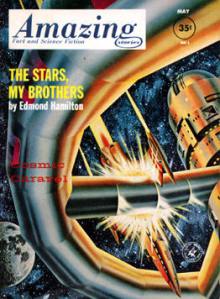
Amazing Stories, May, 1962 Amazing Stories, May, 1962

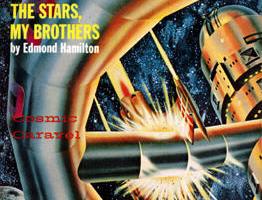
This cover, by George Schelling for the May, 1962 issue of Amazing Stories, is one of my all time favorite pieces of of sci-fi art. I’m not sure what I like so much about it. I suspect the composition is very nice. I also think that the colors and shading on the space station are beautiful. I love the sense of vastness in the space-scape background. And the crashing spaceship conveys a lot of energy. I mean, man, you can almost hear the impact and feel  craft’s speed, can’t you?

Probably the whole of the piece is greater than the sum of its parts, too.

The cover illustrates “The Stars My Brothers” by Edmond Hamilton, who along with E. E. Smith is credited by many with creating the space opera genre back in the thirties and forties. George Schelling, its painter, worked as a sci-fi…

View original post 220 more words

About “The Thrill is Gone”

6 Jul

kentmcdanielwrites's avatarkentmcdanielwrites

Spring, 1970 I heard it the first time. It jumped from the car radio like a revelation: B. B.’s solo that kicks “The Thrill Is Gone” off. It told the unvarnished truth without wasting a note. I bought the 45 that day. I played it till my stereo needle destroyed the grooves. The tune matched my mood. The girl I loved had broke my heart.

b. b. kingI didn’t learn the song then, though. All the bands I was playing in did pretty much top forty. Playing something that soulful was unimaginable to me, I guess.

A decade later I was in Chicago working a regular gig with Aron Burton. Johnny Littlejohn, who I seem to recall was Aron’s brother-in-law at the time, recommended me to him. When Aron talked to me about doing the gig, I said that what I knew about blues came from The Allman Brothers and The Yardbirds…

View original post 110 more words

John W. Campbell art director?

6 Jul

kentmcdanielwrites's avatarkentmcdanielwrites

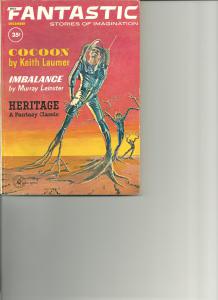
         I READ SOMETHING SURPRISINGin issue #32 of Illustration, a magazine about which I’ve long been curious but had never before picked up—probably due to its $15.00 an issue price tag. Anyhow for some reason, I finally broke down a sprang for a copy, and inside there was a short piece about Robert Adranga, who apparently did a lot of well-received covers for a Hitchcock YA mysteries series called The Three Investigators. I remembered Adranga’s name because he did a cover for Fantastic back in the sixties that I loved (I still have the issue, and the cover was also reproduced in the article.) It turns out that the Fantastic cover was Adranga’s first sale, made while he was yet in art school. The interviewer asked him about it, and it was Adranga’s answer which surprised me. Here’s what he said:

            “I took my portfolio to those two…

View original post 315 more words

Review From Alexiad

6 Jul

kentmcdanielwrites's avatarkentmcdanielwrites

JIMMY STU LIVES!
By Kent McDaniel
(Penumbra Publishing; 2011;
ISBN 978-1935563839; $9.99;
Kindle: $2.99)

Reviewed by Tom Feller

In Robert Heinlein’s 1940 novella, “If This Goes On —“, a fundamentalist Christian leader is elected President in 2012 and proceeds to suspend the Constitution and turn the United States into a theocracy. In Kent McDaniel’s novel, future events have not gone that far, but the separation of church and state is no longer observed, and you might say that the United States is a semi-theocracy.

McDaniel’s story begins in the present. The main character is The Reverend James Stuart “Jimmy Stu” Sloan, founder of the mega-church Church of the Living Lord (COTLL), a three thousand person congregation in Nashville, Tennessee. A widower, Jimmy Stu has lost his faith and decides to have his body cryogenically frozen when he dies.

He is revived in 2140, when the world in some ways is…

View original post 403 more words

Outre’ #1: Cover, flash fiction, natter.

6 Jul

kentmcdanielwrites's avatarkentmcdanielwrites

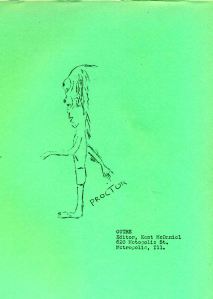
Back in the mists of prehistory when I was fifteen, I edited Outre’ #1, the first of six issues of that zine and the first fanzine I ever edited. Probably I should just let sleeping BEMs lie. Lots of zine editors from back in Sixties would rather their first effort remain unseen, and that’s not a bad idea, really. But the Outre’ was distributed through the Southern Fandom Press Alliance (SFPA), and it occurred to me that a) Ned Brooks, SFPA’s archivist, would have a copy of the issue, and b) there were a couple parts of OutreKM1coverit I wouldn’t mind seeing after all these decades. One was the editorial natter at the start of the issue, in which I had retraced my path into SF fandom. The other was a flash fiction (or short-short, as we called them back then) by my pal John Battle, who was fourteen. Ned…

View original post 1,086 more words

“The Time Awaited”

6 Jul

kentmcdanielwrites's avatarkentmcdanielwrites

I’m posting a video of this song of ours from our last show at The Heartland. I wrote this one (back in the mists of prehistory), and I’ve always sung it when we play out. It occured to me, though, that Dorothy could probably sing it better, and I suggested it to her. That was a couple weeks before the gig, this was the first time she ever sang it, and she sang it great. (I knew she would.)

I wrote this around midnight one summer night in the early 1970’s, sitting on the hood of my car in front of my folks house on Metropolis Street. It just flowed right out–the way I wish all writing of all kinds would for me. I was writing about experiencing  spiritual renewal after a time of emotional dryness. But some people have told me it makes them think of some Zen searcher finally…

View original post 204 more words

“Jimmy Stu (What’s With You?)

6 Jul

kentmcdanielwrites's avatarkentmcdanielwrites

I Wrote “Jimmy Stu” for all the cosmic cowboys who never thought they’d end up on the daily grind–but did. I’m posting a video of the song, from our last show, a performance of it I especially like. For one thing, that  night everybody seemed to find the groove pretty well. For another, though I’ve always thought of the tune as a southern rock/rockabilly thing, Rudy Negrete soloed on it like a Chicago bluesman, and it worked just fine to my ears. If your computer speakers are as lame as mine, I hope you use headphones when you watch this:  

Here are the lyrics.

Jimmy Stu (What’s with You?)

You used to live in the country

up in the ozone, one with the wind and sun

Now you live in the city, and man, it’s a pity

how you run

Jimmy Stu, what’s with you?

Yeah, you used to walk slow

You used…

View original post 95 more words